
Introduction
At Cirque Furniture, we are always looking for practical furniture solutions to the everyday challenges found in modern workplaces.
Whether it is creating privacy within an open-plan office, making power more accessible or allowing a space to adapt to different activities, the right furniture can have a significant impact on how effectively a workplace functions.

Recently completed job at The Forge, London, using Tila Solo Booths.
These challenges do not always require structural changes or a complete office redesign. Sometimes, one carefully selected product can provide a surprisingly effective solution.
From mobile partitions and soundproof booths to integrated cable management and modular seating, here are five clever office furniture products designed to solve common workplace problems hand picked from our Project Managers at Cirque.
1. Constant Changing Layouts: Dancing Wall 2 by Vitra
Workplaces are often needed to adapt to help the ever changing floor plan, with new people coming in and out, as well as the ever changing day to day.
A space might be used for focused work in the morning, a collaborative workshop in the afternoon and a presentation later that day. Team sizes can change, departments may move and new working practices can quickly make a permanent layout feel restrictive.
Traditional partitions can divide an office effectively, but moving them often involves disruption, expense and building work.
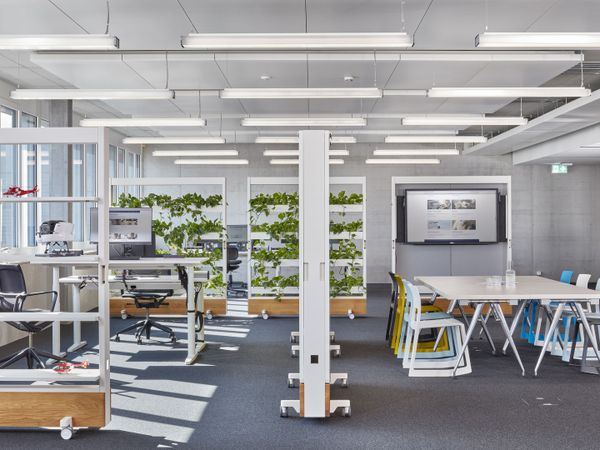
Vitra’s Dancing Wall 2 provides a much more flexible alternative.
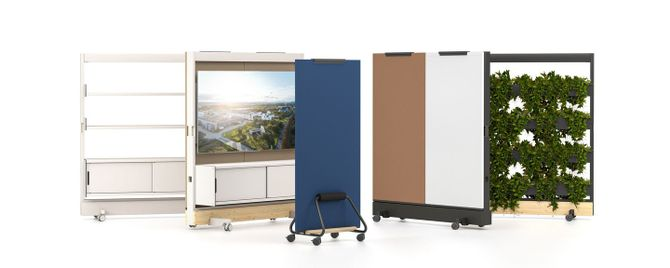
Dancing Wall 2 by Vitra
Designed by Stephan Hürlemann, Dancing Wall 2 is a mobile partition that can divide an office into different zones while also providing practical vertical surfaces and access to power.
The system can be configured in several ways, including as a room divider with removable whiteboards and pinboards, a bookshelf, TV unit, coat rack or plant wall. Different units can be combined to create a wide variety of layouts and working environments.
Because the units are mounted on castors, they can be repositioned as the requirements of a space change. This allows businesses to adapt areas for different team sizes and activities without requiring structural alterations or specialist installation.
2. When Privacy is Needed: Tila Space Solo
Open-plan offices can make communication easier, but they can also make private conversations and video meetings more difficult.
Employees may find themselves searching for somewhere quiet to take a call, speaking beside colleagues who are trying to concentrate or occupying an entire meeting room for a one-person video conference.
As hybrid meetings have become part of everyday working life, this problem has become increasingly common.
The Tila Space Solo is a soundproof phone booth designed for one person. It provides a private environment for phone calls, video meetings and short periods of focused work.
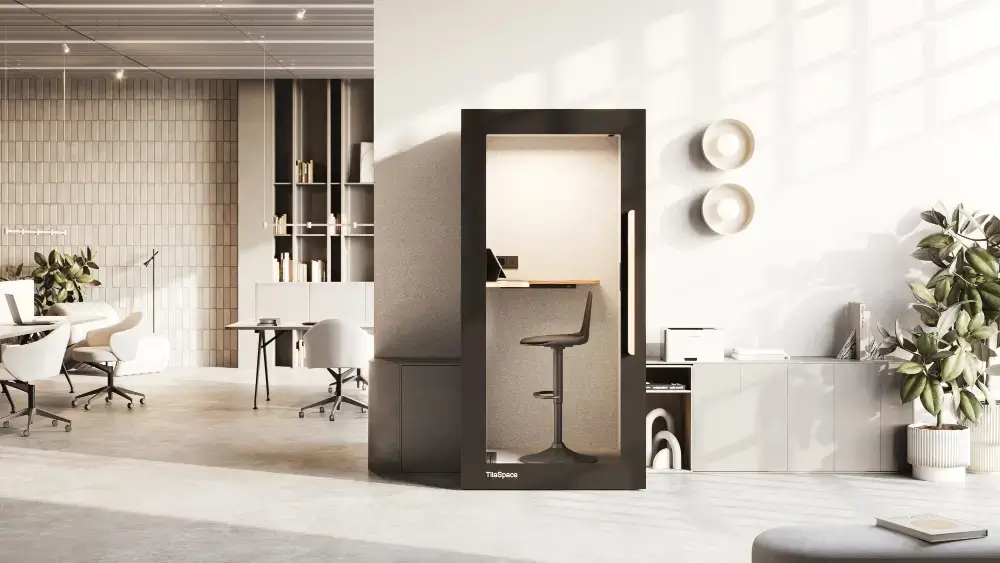
Tila Space Solo by Tila Space
Acoustically insulated walls and double-glazed doors help contain sound within the booth while reducing distractions from the surrounding office. This gives the user greater privacy without disrupting colleagues working nearby.
Ventilation is an important consideration within any enclosed booth. The Solo includes an integrated ventilation system, alongside motion-activated lighting and airflow that begin operating when someone enters.
The booth also includes a hardwood desk and connectivity ports, allowing employees to charge or power their devices while working. Its range of customisation options means that colours and finishes can be selected to suit the wider workplace design.
A single-person booth also uses space more efficiently than a conventional meeting room. It allows larger rooms to remain available for group meetings while giving individuals an appropriate place to take calls.
There is also the Tila Space Duo available, should you wish to have a break away meeting.
For busy workplaces where private calls and video meetings regularly cause disruption, it provides a compact and practical solution.
3. Messy Cables and Inaccessible Power: VWork by Modus
Technology is essential to the modern workplace, but the cables that accompany it can quickly become a problem.
Laptops, monitors, chargers and other devices all require accessible power. Without properly integrated cable management, wires can trail across desks, hang beneath tables or gather around floor boxes.
This can make even a carefully designed workplace appear untidy. It can also make power difficult to reach and create obstacles when employees are setting up their equipment.
The VWork Desk by Modus incorporates cable management into the furniture itself.
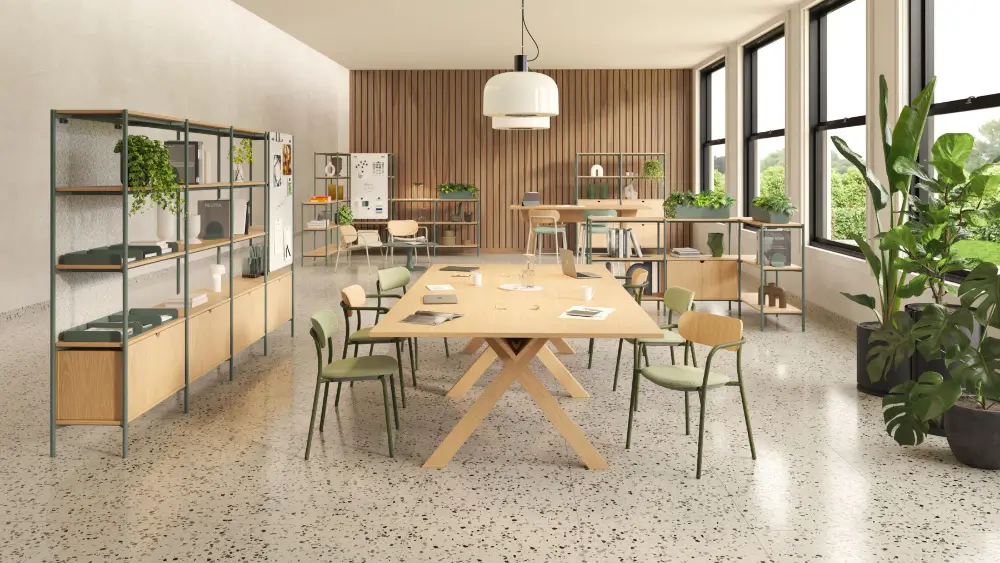
VWork Desk by Modus
Designed by Simon Pengelly, the collection takes its name from the distinctive V-shaped joinery running through the centre of the desk. This channel is designed to carry cables and keep them contained, organised and out of sight.
VWork can also be specified with integrated power, accessed through a solid oak lid in the centre of the desk. Optional steel cable trays and leather cable tidies provide additional ways to manage wires without compromising the appearance of the furniture.
The result is a workstation where employees can connect their devices easily, without cables dominating the desk or surrounding floor space.
VWork is available in several sizes and configurations, including options for one, two, four or six people. A standing-height version is also available for more agile working areas.
Its solid and veneered oak construction introduces a warmer, more natural quality than many conventional desking systems. This allows the product to combine practical technology integration with a more considered, design-led appearance.
The collection also uses FSC-certified timber and is manufactured in Modus’s Somerset factory using renewable energy. Individual components can be separated for reuse or recycling at the end of the product’s life.
By considering connectivity from the beginning, rather than treating it as an accessory added afterwards, VWork creates a tidier and more accessible workstation.
4. Hot-Desking Without Personal Storage: Yellowbox Smart Lockers
Hot-desking gives employees greater freedom over where they work, but removing assigned desks can also mean removing personal storage.
In a traditional office, employees may keep their belongings in a locked drawer beneath their desk. Within a flexible workplace, that drawer can unintentionally tie someone to one particular workstation.
Without an alternative, employees may have to carry laptops, bags, documents and personal items around the office throughout the day. Belongings can also begin to gather around shared desks, undermining the clean and organised environment that hot-desking is intended to create.
Yellowbox Smart Lockers provide employees with secure personal storage while allowing businesses to manage lockers more flexibly.
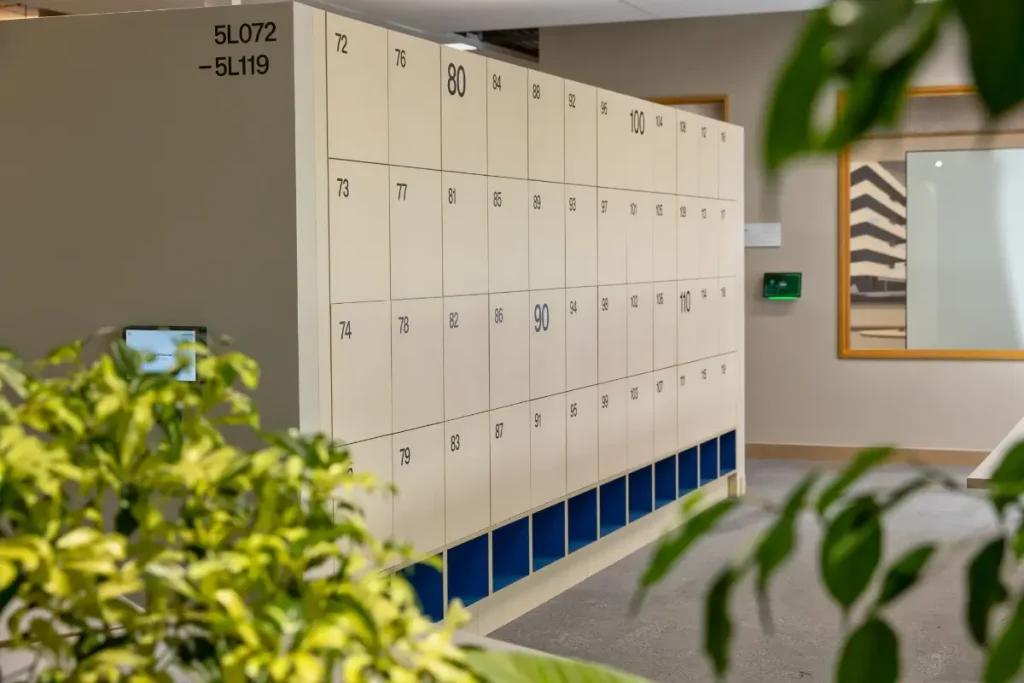
Rather than permanently assigning every employee their own locker, Yellowbox allows lockers to be configured for personal, temporary, shared, team or visitor use. Employees can book a locker when they are working in the office and release it when it is no longer required.
Lockers can be accessed using the Yellowbox app, an existing RFID building pass, a touchscreen PIN, Apple or Google Wallet, or through Microsoft Outlook and Teams. This allows the system to fit around the technology employees already use, without relying on physical keys or manually distributed access codes.
The self-service system also makes locker allocation easier to manage. Employees can select and access an available locker themselves, while workplace teams can use the management dashboard to monitor availability, review usage and configure different locker types.
This can help businesses understand how many lockers are actually required. In a hybrid workplace, where not every employee attends the office on the same day, shared and temporary lockers can make more efficient use of both furniture and floor space.
Yellowbox offers wired and wireless locking options that can be installed on new storage or retrofitted to existing lockers and cabinets. This gives organisations the flexibility to introduce smart access without necessarily replacing their entire storage system.
Cirque Furniture has already seen the value of replacing fixed desk pedestals with lockers within flexible workplace projects. By separating storage from the individual desk, employees are free to move between different settings without losing access to a secure place for their belongings.
Yellowbox builds on this idea by making workplace storage easier for employees to access and simpler for businesses to manage.
5. Rearranging Seating Plans: Chadwick Modular Seating by Herman Miller
Breakout spaces and collaborative areas rarely serve only one purpose.
During a typical working day, the same area might host an informal meeting, a team discussion, individual laptop work or a larger company gathering. A fixed sofa arrangement can limit how effectively that space adapts to each activity.
Chadwick Modular Seating by Herman Miller is designed to create a wide range of seating arrangements from just five simple units.
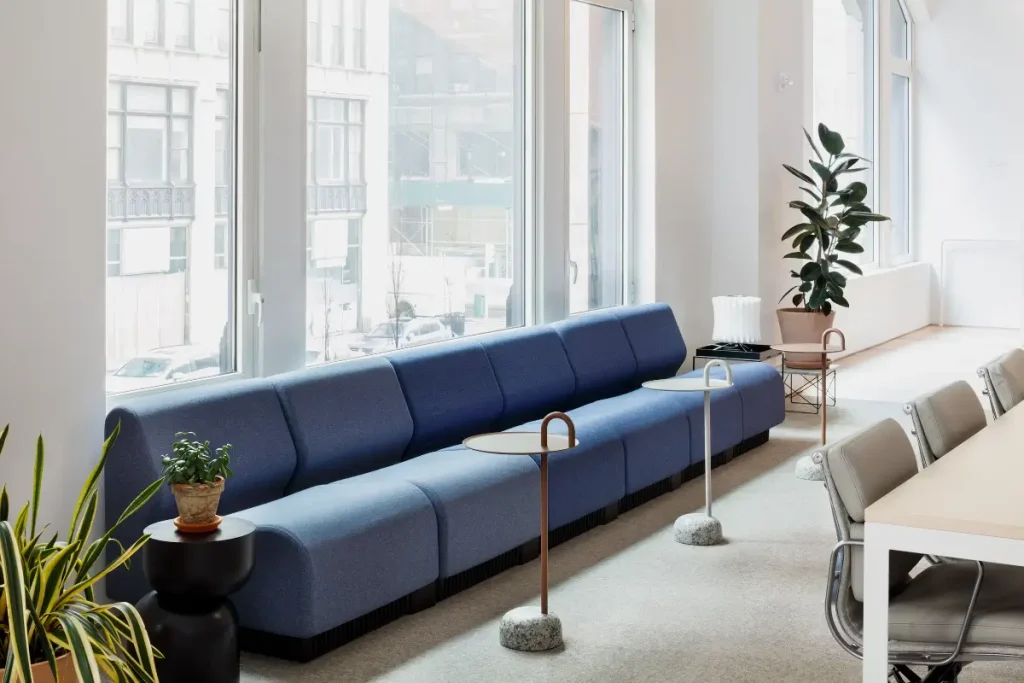
Chadwick Modular Seating by Herman Miller
Originally designed by Don Chadwick in 1974, the system has since been updated with a contemporary seat height and the ability to incorporate power.
Straight and curved modules can be combined to create linear arrangements, gentle curves, circles and more sculptural seating configurations. This allows the furniture to follow the architecture of a space or create different settings within an open-plan environment.
Each module is upholstered on the front, back and sides. This means it can work as an end piece, an internal seat or a standalone chair, depending on the arrangement.
The units connect securely but can also be unlocked when the layout needs to change. This makes it possible to reconfigure the seating without replacing the furniture or committing the area to one permanent setup.
Power integration also allows the system to support informal laptop work and longer collaborative sessions, rather than functioning only as somewhere to sit briefly.
Chadwick’s longevity is part of what makes it particularly interesting. Although the original design is more than 50 years old, its modularity responds remarkably well to the flexibility now required within contemporary workplaces.
For breakout areas, reception spaces and collaborative zones, Chadwick Modular Seating provides a system that can evolve alongside the people and activities using it.
Conclusion
Every workplace has small problems that can affect how comfortably and efficiently people work.
Layouts become outdated, private calls disrupt colleagues, cables gather around desks, hot-desk users lose access to personal storage and fixed seating prevents spaces from adapting.
The five products featured here approach these problems in different ways.
Vitra’s Dancing Wall 2 allows employees to reshape and divide a workplace without permanent building work. The Tila Space Solo creates a private environment for calls and video meetings. Modus VWork integrates power and cable management into the desk itself. Yellowbox Smart Lockers provide secure storage for flexible workers, while Herman Miller’s Chadwick Modular Seating allows collaborative areas to be rearranged as requirements change.
The most effective furniture specifications are not simply based on appearance. They consider how people use a space, identify the frustrations that could affect them and select products that provide practical, long-term solutions.
At Cirque Furniture, we work with several manufacturers to find the right furniture for each client, project and workplace challenge.
If your office has a problem that the right furniture could help solve, contact our team at info@cirquefurniture.com to discuss your requirements.

